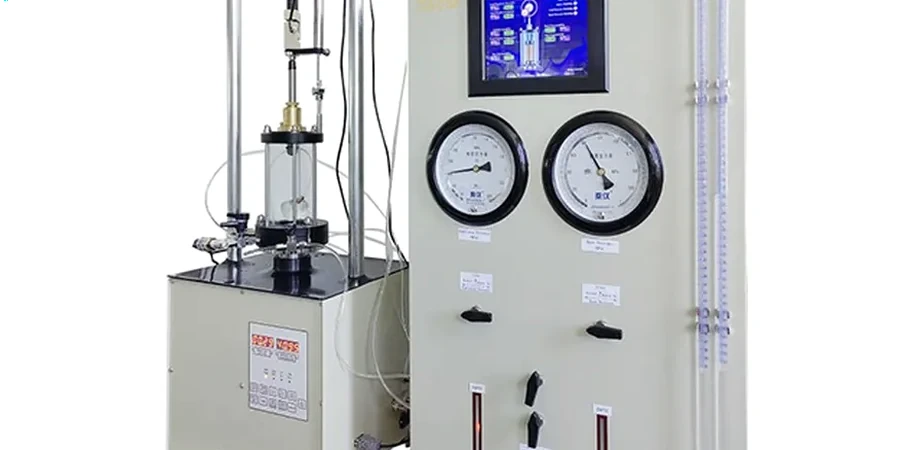
Worcester's landscape, shaped by glacial retreat and the Blackstone River valley, presents a complex geological profile of dense tills, varved clays, and occasional organic deposits. These soils react unpredictably under the heavy structural loads common in New England construction. A standard investigation often misses the critical undrained behavior of saturated fine-grained layers, especially given the city's average 48 inches of annual precipitation and snowmelt cycles. The grain-size analysis helps classify the material, but only a comprehensive triaxial test can reveal how Worcester's silty clays will truly perform under the combined stress of a foundation and fluctuating groundwater table. We apply multi-stage consolidated-undrained protocols to give engineers the effective stress parameters needed for safe design.
Effective cohesion and friction angle from a triaxial test are not just numbers; they are the difference between a cost-efficient footing and a long-term settlement problem in Worcester's varved clays.
Quick answers
What is the typical turnaround time for a triaxial test in Worcester?
A standard consolidated-undrained test with pore pressure measurement typically takes 7 to 10 business days from sample receipt. This includes saturation, consolidation, and the shearing phase. We can expedite to 5 days for critical path items.
What is the cost of a triaxial test?
For a single specimen, the cost ranges from US$1,640 to US$2,580 depending on the type of test (CU, CD, or UU) and the number of confining stresses required. A full profile of three specimens usually falls at the higher end of the range per test due to the increased reporting detail.
How do you ensure the sample is not disturbed before testing?
Samples are transported in sealed Shelby tubes inside cushioned, temperature-controlled containers. We perform X-ray radiography or CT scanning on select samples to check for internal fissures before trimming, following the guidelines of ASTM D4220 for preserving and transporting soil samples.
Which confining stresses do you recommend for a Worcester project?
We select confining stresses based on the proposed foundation depth and the in-situ effective overburden pressure. For a typical 15-foot basement excavation near Main Street, we might use 5, 15, and 30 psi to bracket the expected stress range and accurately define the Mohr-Coulomb failure envelope.
Can you test granular soils from Worcester's glacial outwash?
Yes. While triaxial testing is most common on cohesive soils, we perform consolidated-drained tests on reconstituted or undisturbed granular samples. For loose outwash sands, we can also run triaxial tests to evaluate liquefaction potential by cycling the axial load, complementing our in-situ CPT testing for a comprehensive seismic assessment.