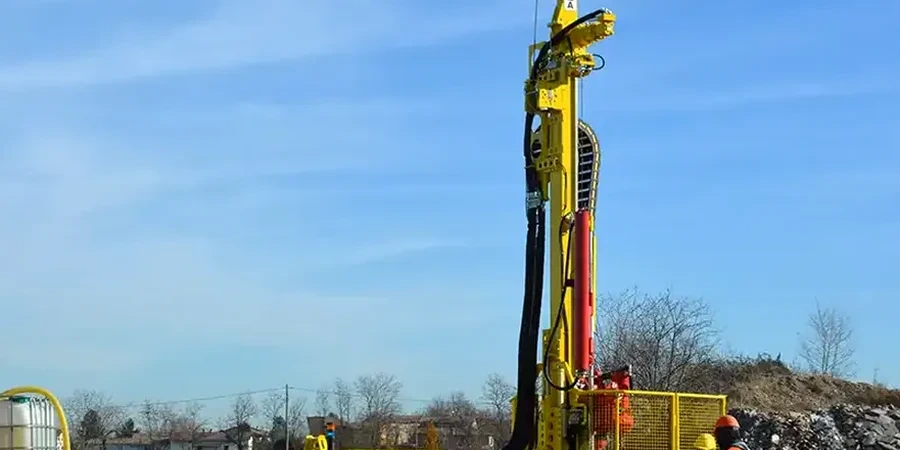
I remember a job on Shrewsbury Street, right where the old warehouses are getting converted into mixed-use. The developer had a set of borings from 1994, and the logs showed refusal at 15 feet. We mobilized a CME-75 rig, started driving split spoons, and sure enough, we hit weathered schist way shallower than the old report indicated. In Worcester, you learn quickly that glacial Lake Hitchcock didn't just leave nice flat sand plains, it left a chaotic mix of dense till, lacustrine clay, and bedrock ridges that can swing 20 feet in elevation across a single lot. The SPT is the one test that gives you a number you can actually work with on site, right then, without waiting for lab results. When the spoon comes up with three inches of recovery and the blow count jumps past 50, everyone on site knows we just found the bearing layer. In this city, where the zoning overlay for transit-oriented development is pushing taller wood-frame over podium structures into areas that were single-family for a century, understanding that refusal depth is everything. A proper SPT drilling program maps those transitions before the excavators arrive, so the structural engineer isn't redesigning footings mid-pour. The 2015 addition to the Worcester Art Museum had to deal with exactly this, variable rock surface across a tight urban site, and the geotechnical report relied heavily on SPT refusal depths to set the micropile tip elevations.
In Worcester's glacial terrain, an SPT refusal depth is often more valuable than a lab strength test, it tells you exactly where the digging stops and the real engineering begins.
Methodology and scope
ASTM D1586 is the governing standard, and in Massachusetts it gets layered with the 9th Edition IBC Chapter 18 and the Mass Amendments. The test procedure sounds straightforward: a 140-pound hammer falling 30 inches, driving a 2-inch OD split spoon 18 inches, counting blows per 6-inch increment. But the details matter here. The Worcester formation, that metamorphic bedrock that underlies much of the city, weathers into a silty, micaceous residual soil that can look like competent till but loses strength fast when saturated. We run SPTs at 2.5-foot intervals through the overburden and switch to 5-foot intervals once we hit bedrock, using the N-value not just for bearing capacity but for liquefaction screening too. The 2015 USGS seismic hazard maps bumped Worcester up slightly for the long-period spectral acceleration, and that changed the conversation about site class. An SPT profile that gives you an average N-value of 25 in the upper 100 feet puts you in Site Class D, which is the default for half the city, but if you hit rock at 40 feet and the N-values average above 50, you might get Class C and save real money on the lateral system. We often pair the SPT data with
grain size analysis on the split spoon samples to confirm the USCS classification, because a silty sand with fines content above 35 percent behaves very differently under seismic loading than a clean sand with the same blow count.
Site-specific factors
Central Massachusetts winters punish assumptions. The frost depth in Worcester is 48 inches by code, and the freeze-thaw cycling in the saturated silts overlying the till creates a near-surface zone of disturbed soil that can lose 30 percent of its blow count from November to April. We see this on sites along Route 146 where the grade cuts expose the soil profile, summer SPTs in the same material run 8 to 12 blows, winter runs drop to 5 or 6 in the upper 6 feet. If you schedule your drilling in January and don't account for seasonal softening, your bearing capacity numbers will be conservative, and you'll overdesign the footings. The bigger risk is the undiscovered boulder. Worcester sits on the edge of the terminal moraine, and the ice left granite erratics the size of cars buried in the till. An SPT that hits refusal at 8 feet could be a boulder, not bedrock. One boring tells you nothing, you need a grid of at least three to distinguish a perched erratic from the actual ledge surface. The 2011 tornado that tore through the Oxford-Worcester line also reminded everyone that uplift isn't just a coastal problem, those winds pulled shallow footings right out of the ground in the sandier pockets of the Lake Hitchcock deposits.
Quick answers
What does an SPT test cost for a typical residential project in Worcester?
For a standard residential lot in Worcester, a single SPT boring to 25 feet depth with three split spoon samples and a basic log runs between US$630 and US$820. The range depends on access constraints, whether we need to core through pavement, and if the site is in one of the tighter urban lots near Vernon Hill or Grafton Hill where the drill rig setup requires traffic management.
How deep do you need to drill SPT borings for a two-story addition in Worcester?
The Massachusetts Building Code requires borings to extend below the foundation influence zone, which for a two-story wood-frame addition on spread footings typically means 20 to 30 feet. But in Worcester, the controlling factor is often bedrock depth. If we hit refusal at 12 feet, the boring stops there. If the overburden is deeper, like in the filled areas near Indian Lake, we go to 30 feet and run an SPT every 2.5 feet to capture the full soil profile for the bearing capacity calculation.
Do you need a separate test for soil classification, or does the SPT cover that?
The split spoon recovery gives you a disturbed sample that is perfectly adequate for visual classification and laboratory index testing. We typically run a sieve and hydrometer on one representative sample per boring to confirm the USCS group symbol, following ASTM D2487. The SPT blow count and the soil classification together give you the full picture, the N-value tells you density, the gradation tells you drainage behavior and frost susceptibility, both of which matter a lot in Worcester's freeze-thaw climate.