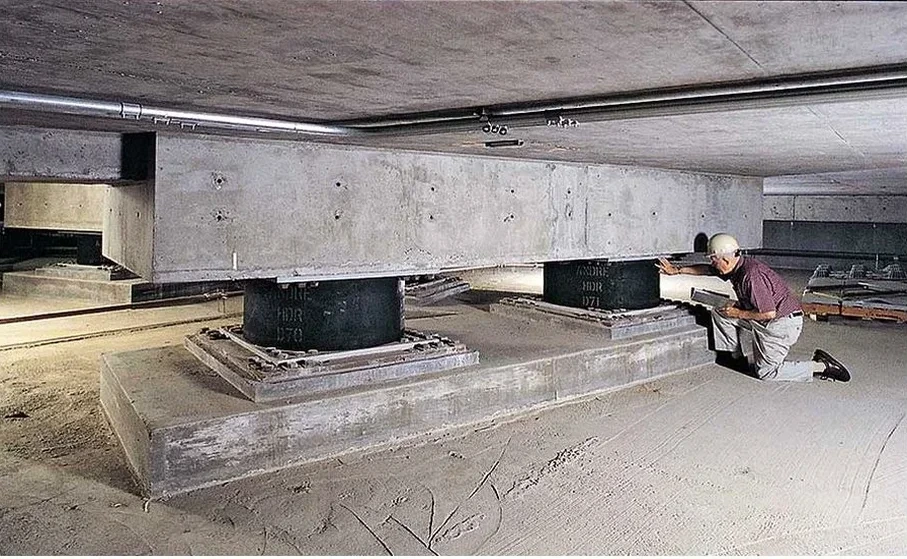
Worcester sits on a foundation of complex glacial till and bedrock valleys shaped by the last ice age. The city's population of over 206,000 lives and works atop soils that can amplify seismic waves in surprising ways. While the Northeast isn't California, the 1755 Cape Ann earthquake—estimated at magnitude 6.0—rattled chimneys and cracked foundations across central Massachusetts. Today's building codes recognize that risk. Base isolation seismic design provides a proven method to protect critical facilities, healthcare infrastructure, and historic structures in Worcester by inserting flexible bearing systems between the foundation and superstructure. This approach isn't about strengthening the building to resist shaking; it's about reducing the energy that enters the building in the first place. For sites with deep soft soils near the Blackstone River, combining isolation design with a site-specific liquefaction assessment ensures the ground beneath the isolators remains stable during a design-level event.
A well-designed base isolation system can reduce seismic forces on a building's superstructure by 60 to 80 percent compared to a fixed-base design.
Site-specific factors
Worcester's subsurface profile frequently includes glaciolacustrine deposits—silts, clays, and fine sands deposited in glacial Lake Hitchcock. These soils have moderate stiffness but can settle differentially under concentrated loads. When a building sits on isolators, the entire superstructure weight concentrates at discrete bearing points, creating high-stress zones at the foundation interface. If those points bear on compressible layers, differential settlement can tilt the isolation plane and bind the bearings. Another concern specific to Worcester is the frost depth, which reaches 48 inches below grade. The isolation moat—the perimeter gap allowing the building to move—must be detailed to prevent ice damming and debris intrusion through New England winters. The project team addresses these risks by integrating the base isolation seismic design with a rigorous foundation investigation, often including test pits and plate bearing tests to verify bearing capacity directly beneath isolator locations.
Quick answers
What types of buildings in Worcester benefit most from base isolation?
Hospitals, emergency response facilities, data centers, and historic masonry structures gain the most value. These buildings must remain operational after an earthquake or have fragile architectural fabric that cannot tolerate drift. The Worcester medical district around UMass Memorial has several candidates where isolation would protect both building function and sensitive equipment.
How much does base isolation seismic design cost for a project in Worcester?
For a typical mid-rise structure in the Worcester area, the engineering design, analysis, and peer review package ranges from US$4,190 to US$8,420 depending on building complexity, number of bearings, and the extent of geotechnical coordination required. This excludes bearing fabrication and installation costs.
Does base isolation require a different foundation type?
Not necessarily, but it does impose concentrated loads beneath each isolator. The foundation—often a mat or thickened slab with pedestals—must be stiff enough to distribute those loads uniformly into the bearing soil. On Worcester's glacial till, this is usually achievable with a well-designed reinforced concrete mat. For softer varved clay deposits, ground improvement or deep foundations may be needed to support the isolator pedestals.