← Home · Slopes & Walls

Slope Stability Analysis in Worcester, MA — Geological and Engineering Approach

Together, we solve the challenges of tomorrow.

LEARN MORE →

One of the most common mistakes we see with earthwork contractors in Central Massachusetts is assuming that a visually stable cut in glacial till will stand unsupported through a wet spring. Worcester's subsurface is deceptive: dense hardpan overlying slick varved clays or weathered schist can hold a near-vertical face until a thaw cycle introduces pore pressure into tension cracks. We have analyzed failures on sites along the Leicester line where a 15-foot cut let go within 48 hours of meltwater infiltration. A proper slope stability evaluation does not just generate a factor of safety — it interprets the hydrogeologic triggers that cause rotational or translational failure in these glacially overconsolidated soils. When the project schedule demands excavation ahead of winter shutdown, we often pair stability modeling with a seismic refraction survey to map bedrock depth and identify perched groundwater pockets that keep the phreatic surface elevated well into December.

A stable-looking cut in Worcester till can fail within hours of thaw — the trigger is almost always unaccounted pore pressure, not an error in the static slope angle.

Methodology and scope

In our experience around the Seven Hills and the Blackstone River terraces, the critical failure surface is rarely where the textbook says it should be. Worcester's glacial stratigraphy creates strength contrasts that favor compound failures: a stiff lodgement till overlies a softer, normally consolidated lacustrine silt, and the slip circle flattens out along that contact. We model these scenarios with both limit equilibrium (Spencer and Morgenstern-Price) and, on higher-consequence slopes, finite element stress-deformation analysis to capture progressive failure. Shear strength selection relies on laboratory triaxial testing under consolidated-undrained conditions with pore pressure measurement — a step that shortcut site investigations skip. The payoff is a design phi' and c' that reflect actual drained behavior of the clay fraction, not an assumed value from SPT blow counts. For deep cuts adjacent to existing structures or I-290 retaining walls, we also evaluate the influence of construction-induced vibration and temporary surcharge from excavated stockpiles placed too close to the crest.
Slope Stability Analysis in Worcester, MA — Geological and Engineering Approach
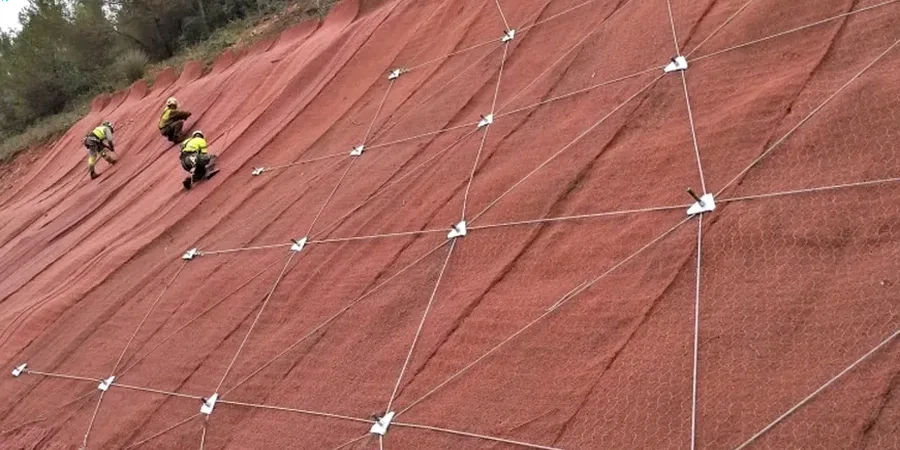
Technical reference image — Worcester

Site-specific factors

The slope stability rig we mobilize around Worcester County is not a single piece of equipment — it is a combination of a track-mounted CPT unit for rapid stratigraphic profiling and a CME-75 drill rig for Shelby tube sampling and SPT in the till. When a developer on Grafton Hill called us after a temporary excavation slumped into a neighboring parking lot, the first thing we did was push a pore pressure dissipation test to confirm that the clay seam at 12 feet depth was still at 85 percent excess pore pressure from glacial loading. That sort of data changes the remediation conversation immediately. The biggest risk in Worcester is not the soil itself — it is the construction sequence: opening a cut in October, letting it sit through freeze-thaw cycles, and then placing a building footing just behind the crest in April. That is a recipe for a progressive failure that no amount of benching can fix.

Need a geotechnical assessment?

Reply within 24h.

Email: contact@geotechnical-engineering.vip

Reference parameters

ParameterTypical value
Analysis methodLimit equilibrium (Spencer, Morgenstern-Price) + FEM where required
Failure mode evaluatedRotational, translational, compound, and wedge sliding along bedrock contact
Shear strength sourceCIU triaxial with pore pressure measurement (phi' and c') per ASTM D4767
Pore pressure modelSteady-state seepage + transient drawdown / rapid recharge scenarios
Seismic coefficient (kh)Per IBC 2021 and ASCE 7-22 site class D (Worcester glacial soils)
Target factor of safety1.5 (long-term static), 1.1–1.2 (pseudo-static seismic per local jurisdiction)
Remediation options modeledSoil nailing, tieback anchors, regrading, drainage blankets, buttress fills

Related services

01

Slope stability analysis and design

Limit equilibrium and finite element modeling for cuts, fills, and natural slopes. Includes transient seepage analysis, seismic pseudostatic evaluation, and factor of safety documentation per IBC and ASCE 7 requirements.

02

Instrumentation and monitoring

Installation of slope inclinometers, piezometers, and survey monuments to track movement and pore pressure during construction. Real-time data interpretation for construction-phase decision-making.

03

Remediation and stabilization design

Design of soil nail walls, tieback anchors, drainage systems, regrading plans, and buttress fills for slopes that do not meet minimum safety factors under existing or proposed conditions.

Reference standards

ASCE 7-22 (Minimum Design Loads and Seismic Criteria), IBC 2021 Chapter 18 (Soils and Foundations), ASTM D4767 (Consolidated Undrained Triaxial Compression Test), ASTM D1586 (Standard Penetration Test), FHWA Geotechnical Engineering Circular No. 3 (LRFD Seismic Analysis)

Quick answers

What is the typical cost range for a slope stability analysis in Worcester?

For a residential or light commercial slope evaluation in the Worcester area, the cost typically ranges from US$1,410 to US$4,220 depending on the slope height, complexity of the stratigraphy, and whether laboratory triaxial testing is required. Steep cuts over 15 feet, sites near water bodies, or slopes requiring finite element modeling will be at the upper end of that range.

Do I need a slope stability analysis for a single-family home addition on a sloping lot?

If your lot has a slope steeper than 3:1 (horizontal:vertical) and you are excavating within a distance equal to the slope height from the crest or toe, the Worcester building department will likely require a geotechnical report addressing stability. The analysis must demonstrate a factor of safety of at least 1.5 for long-term static conditions, and we typically recommend it for any cut deeper than 4 feet in Worcester's glacial soils.

How long does a slope stability investigation and report take?

A typical slope stability investigation in Worcester takes two to three weeks from mobilization to final report. The field program — drilling, sampling, and possibly CPT soundings — takes two to four days. Laboratory triaxial testing adds seven to ten days to measure effective shear strength parameters. The analysis and report preparation follow immediately, and we coordinate submissions with the local building official.
Location and service area

We serve projects in Worcester and surrounding areas.

View larger map