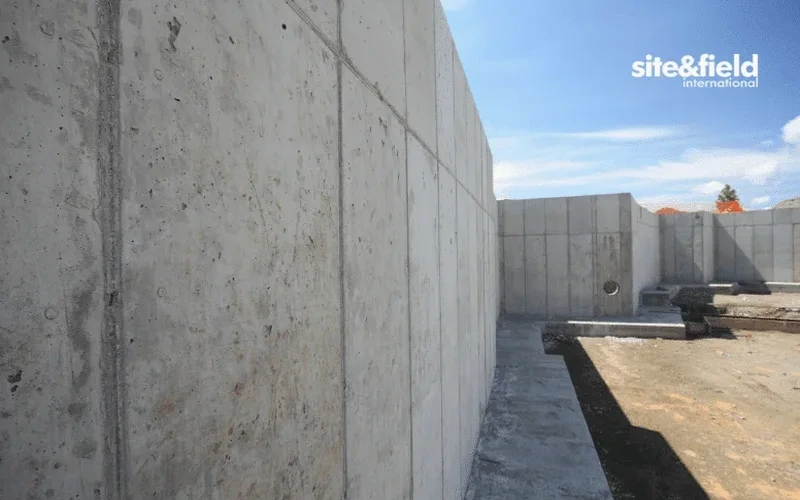
Worcester sits on a complex glacial geology where dense till, varved clays from glacial Lake Nashua, and scattered bedrock outcrops create unpredictable bearing conditions within the same property line. The city’s average frost depth of 48 inches and Seismic Design Category C per IBC mean a retaining wall over 4 feet cannot rely on rule-of-thumb dimensions — it demands a site-specific design that accounts for active earth pressure, seasonal groundwater fluctuation, and the possibility of encountering a shallow refusal surface just 3 to 6 feet below grade. The test pits program often becomes the first step here, because continuous coring through cobble-rich lodgement till requires a practical, direct-exposure method before drilling equipment is mobilized.
A Worcester retaining wall is only as reliable as the soil parameter assumptions behind it — get the phi angle wrong and you undersize the footing by 30%.
Methodology and scope
With a population approaching 210,000 and a built environment that climbs across seven hills, Worcester presents retaining wall challenges where height differentials routinely exceed 12 feet and surcharge loads from adjacent roadways — like the I-290 corridor or the steep grades along Belmont Hill — must be factored into the lateral earth pressure calculation. The design process integrates Coulomb and Rankine earth pressure theories with a factor of safety not less than 1.5 against sliding and 2.0 against overturning, as required by ASCE 7-22 Section 11.0. Global stability checks using Spencer’s method are performed when the wall supports a sloped backfill steeper than 2H:1V, and we specify drainage provisions that accommodate Worcester’s 48-inch frost penetration without allowing hydrostatic buildup behind the stem. Cantilever, gravity, mechanically stabilized earth, and anchored systems are each evaluated against the actual soil stratigraphy logged during investigation.
Quick answers
At what height does a retaining wall require a permit and engineering design in Worcester?
Per the Massachusetts State Building Code (780 CMR) which adopts the IBC, any retaining wall over 4 feet in height measured from the bottom of the footing to the top of the wall requires a building permit and must be designed by a qualified engineer. Walls supporting a surcharge — such as a driveway, parking area, or building foundation — may require engineering even if under 4 feet.
What does a retaining wall design package for a Worcester property typically include?
The package includes a geotechnical investigation report with soil boring or test pit logs, laboratory shear strength and classification data, bearing capacity and sliding/overturning calculations, global stability analysis when applicable, structural design of the wall stem and footing with reinforcement details, drainage specifications including weep holes or strip drains, and stamped construction plans ready for permit submission to the City of Worcester Inspectional Services.
What is the typical cost range for a retaining wall design in Worcester?
Retaining wall design fees in the Worcester area generally range from US$1,190 for a straightforward gravity wall under 6 feet with a simple soil profile to US$4,620 for a taller MSE or anchored system requiring a full geotechnical investigation, laboratory testing, global stability modeling, and construction-ready plan sheets. The final scope depends on wall height, surcharge conditions, and site access.
How do you account for frost depth in a Worcester retaining wall design?
The footing bottom must extend at least 48 inches below finished grade to sit below the frost line. We also specify free-draining backfill material meeting ASTM D2487 gradation requirements and a continuous drainage system at the base of the wall to prevent water from being trapped and freezing behind the stem, which would generate lateral ice-lensing pressures that can crack or displace the wall during a prolonged central Massachusetts winter.