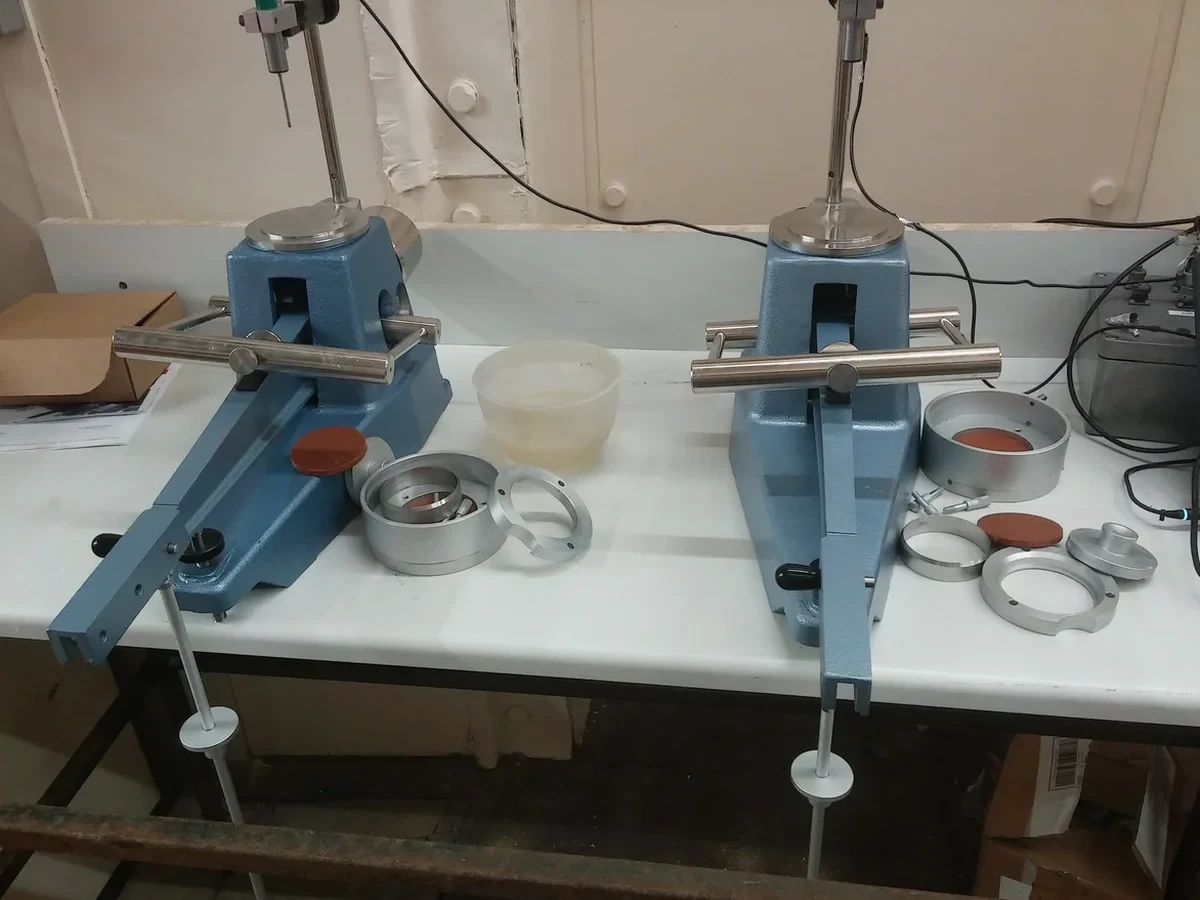
With Worcester sitting on a complex glacial geology at roughly 480 feet elevation, the fine-grained soils that dominate the Seven Hills landscape demand precise classification. Atterberg limits testing—liquid limit, plastic limit, and the resulting plasticity index—provides the fundamental parameters for predicting how these silts and clays will behave under load and through New England freeze-thaw cycles. Our laboratory processes samples daily from sites across Worcester County, from downtown redevelopment parcels to infrastructure corridors along I-290. The values we derive feed directly into bearing capacity calculations, settlement predictions, and earthwork specifications. Without this data, a geotechnical report is incomplete. For deeper stratigraphic context, the limits data pairs with SPT drilling results that capture density and consistency at depth, building a layered model of the subsurface that reflects actual conditions encountered in the field.
A plasticity index above 30 in Worcester's varved clays signals a soil with high shrink-swell potential—critical to know before placing any foundation element.
Site-specific factors
Per the Massachusetts State Building Code (780 CMR), which incorporates IBC 2021 with amendments, foundation investigations must characterize fine-grained soils for their volume change potential. Worcester's post-glacial clays present a specific hazard: moderate to high shrink-swell behavior tied to seasonal moisture fluctuation. The plasticity index quantifies this risk numerically—soils with PI exceeding 25 require engineered mitigation such as moisture barriers, deepened footings, or removal and replacement with granular structural fill. Skipping Atterberg limits testing on a site underlain by lacustrine deposits is not a defensible engineering decision. Cracking in lightly-loaded structures, differential heave at slab-on-grade construction, and excessive lateral earth pressures on basement walls are all documented failure modes in the region. A single set of limit determinations, run on representative samples from each cohesive stratum encountered, provides the parameter needed to trigger—or rule out—special foundation provisions before construction documents are finalized.
Quick answers
What is the typical cost for Atterberg limits testing in Worcester?
For standard Atterberg limits determination (liquid limit and plastic limit) on a single sample, testing typically ranges from US$60 to US$110. The price depends on whether the test is ordered standalone or as part of a larger index testing package that includes grain-size analysis and moisture content. Rush turnaround may carry a surcharge. Contact the lab with your project specifics for a firm quote.
How long does it take to get Atterberg limits results back?
Standard turnaround is 3 to 5 business days from sample receipt. The procedure requires oven-drying, pulverization, and careful titration of water content at each limit determination—steps that cannot be rushed without compromising accuracy. Expedited 24- to 48-hour turnaround is available for active construction where excavation has exposed unexpected soil conditions and a classification is needed immediately.
Why are Atterberg limits important for building on Worcester's glacial clays?
The varved clays and silts deposited by glacial Lake Hitchcock can exhibit high plasticity and significant shrink-swell potential. The plasticity index derived from Atterberg limits quantifies this behavior, allowing the design team to specify appropriate foundation depths, moisture control measures, and structural reinforcement. Without this data, a foundation placed on high-plasticity clay risks differential movement, wall cracking, and long-term serviceability issues that are expensive to remediate after construction.