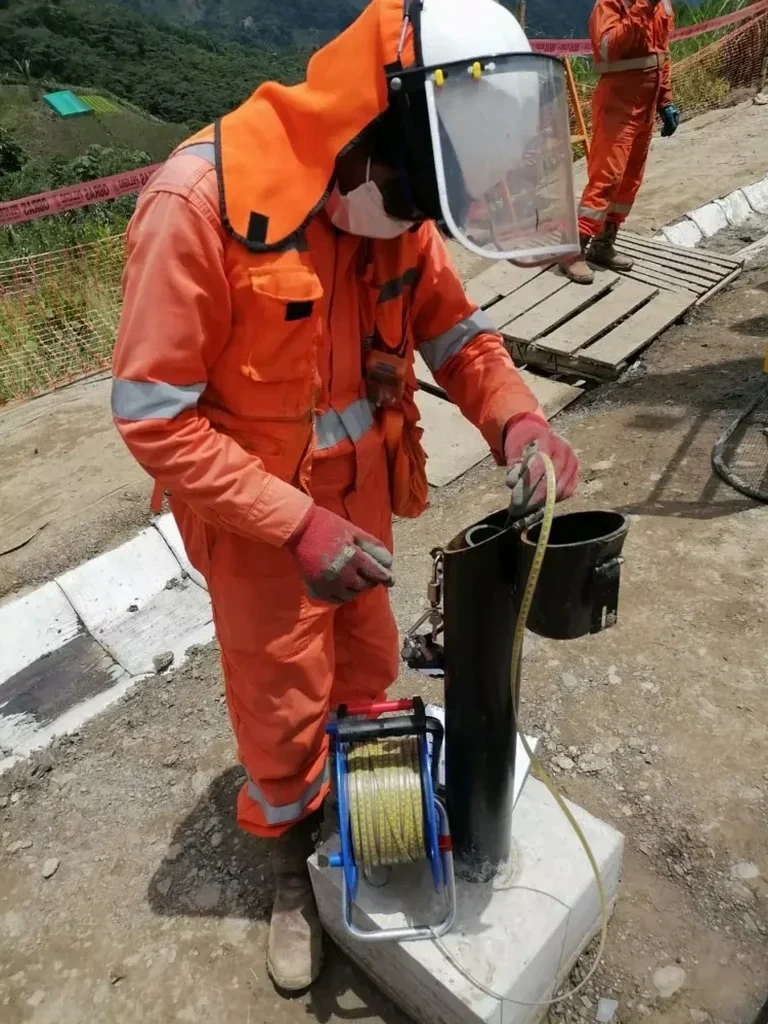
Worcester’s glacial terrain presents a subsurface story written by Lake Hitchcock sediments and drumlin till, where a standard split-spoon often misses the thin varved clay seams that dictate settlement behavior. Running a CPT here means pushing through outwash sands that can shift from dense to loose within a vertical foot, a condition that challenges any shallow foundation on the city’s seven hills. The cone’s continuous tip resistance and sleeve friction profile captures those transitions without the disturbance of a borehole, which matters when you’re placing footings near the Blackstone River floodplain. For deeper infrastructure, we often combine cone data with an SPT drilling program to correlate N-values where the CPT refusal hits bouldery lodgement till, ensuring the geotechnical model reflects both the fine-grained matrix and the coarse obstructions that define Worcester’s glacial stratigraphy.
Continuous CPT profiles in Worcester’s varved clays provide consolidation parameters that disturbed lab samples simply cannot replicate.
Methodology and scope
On sites near Indian Lake or along the I-290 corridor, we routinely encounter urban fill overlying organic silt that compresses like a sponge under load. A CPT rig—typically a 20-ton truck-mounted unit with a 15 cm² cone—logs this contact at centimeter-scale resolution, giving the design team a precise depth to competent bearing strata without the guesswork of intermittent sampling. The test runs per ASTM D5778, measuring cone resistance (qc), sleeve friction (fs), and dynamic pore pressure (u2) when a piezocone is deployed. From these three channels we derive the soil behavior type (SBT) using Robertson’s normalized charts, a method that classifies the profile continuously rather than at 5-foot intervals. In Worcester’s varved clays, the pore pressure dissipation test becomes critical: watching u2 decay tells us the coefficient of consolidation (cv) directly, which feeds into time-rate settlement analyses that a lab oedometer test, run on a disturbed sample, would misrepresent by 30% or more.
Reference standards
ASTM D5778-20: Standard Test Method for Electronic Friction Cone and Piezocone Penetration Testing of Soils, ASTM D2487-17: Standard Practice for Classification of Soils for Engineering Purposes (Unified Soil Classification System), IBC 2021 / Massachusetts State Building Code (780 CMR), 10th Edition, FHWA Geotechnical Engineering Circular No. 5: Evaluation of Soil and Rock Properties (Sabatini et al., 2002), ASCE 7-22: Minimum Design Loads and Associated Criteria for Buildings and Other Structures
Quick answers
What does CPT testing cost for a typical Worcester residential lot?
For a single-family home site in the Worcester area, expect between US$150 and US$260 per test location, depending on depth, access for the 20-ton truck, and whether piezocone or seismic modules are specified. Most residential investigations require two to four pushes to cover the building footprint, with mobilization included in the quote.
How deep can a CPT rig push in Worcester's glacial till?
In the dense lodgement till that underlies much of the city, refusal typically occurs between 20 and 40 feet when the cone encounters boulders or bedrock. In the deeper lakebed clays along the Blackstone River corridor, we routinely reach 80 to 100 feet before hitting refusal, provided the rig has sufficient reaction weight and the clay is normally consolidated.
Does CPT replace soil borings entirely on a Worcester project?
Not always. CPT provides continuous stratigraphy and excellent pore pressure data, but it does not recover physical samples for lab classification or strength testing. On complex sites, we recommend pairing CPT pushes with at least one mud-rotary boring to collect undisturbed Shelby tube samples of the varved clay and confirm the SBT classification with Atterberg limits and triaxial tests.
How quickly can I get the CPT logs and design parameters after the field test?
Preliminary logs with SBT classification and corrected cone resistance are typically emailed within 24 hours of test completion. A full geotechnical report with foundation recommendations, consolidation parameters derived from dissipation tests, and seismic site class (if SCPT was run) follows within five to seven business days, depending on the project scope.