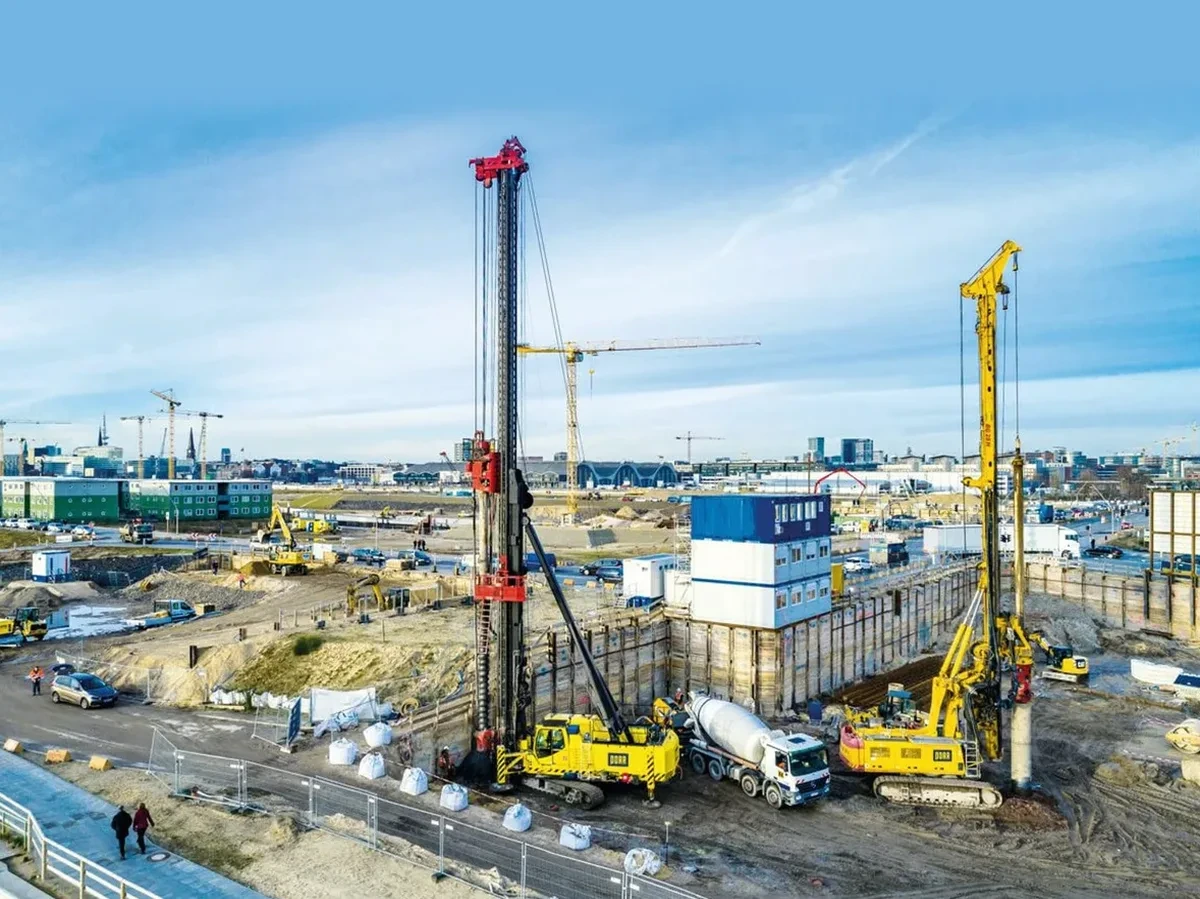
Worcester sits at an elevation of 480 feet on a landscape shaped by the last glacial retreat, leaving behind a complex stratigraphy of dense glacial till over bedrock that varies wildly in depth. The city’s 206,000 residents live atop soils where a shallow footing that works on one side of a street may fail completely thirty yards away due to buried boulders or a sudden drop in the till surface. Pile foundation design across the Seven Hills region deals directly with this unpredictability. A thorough subsurface investigation—often beginning with spt-drilling to log refusal depth and sample cohesionless layers—provides the baseline data for selecting between driven H-piles, drilled shafts, or micropile alternatives. When bedrock is shallow, end-bearing piles socketed into schist or granite offer settlement control that spread footings simply cannot guarantee, especially near the Blackstone River where alluvial deposits mask the competent bearing stratum.
A pile tip socketed 3 diameters into competent granite can carry 4 times the load of the same pile bearing on dense till—the difference between a routine design and a future claim.
Site-specific factors
The freeze-thaw cycles in Worcester—where average January lows hit 17°F and the ground freezes to 48 inches—create a frost heave risk that eliminates shallow bearing options for unheated structures. A pile foundation design addresses this by placing the bearing stratum well below the frost penetration depth, but the real hazard lies in the transition zone: if a pile cap is not isolated from the surrounding frost-susceptible silt, adfreeze forces can generate uplift pressures exceeding 30 kips on a single pile group. The 1953 Worcester tornado and the 2011 earthquake centered in Virginia, felt across Massachusetts, remind engineers that lateral demands from wind and low-probability seismic events must be accounted for even in a region not known for high seismicity. The combination of steep topography and the occasional soft clay lens trapped between till layers demands a site-specific pile load test program, not just empirical correlations from other parts of the Northeast.
Reference standards
ASCE 7-22: Minimum Design Loads and Associated Criteria for Buildings and Other Structures, IBC 2021 / 780 CMR: Massachusetts State Building Code, AASHTO LRFD Bridge Design Specifications, 10th Edition (2023), ASTM D1586: Standard Test Method for Standard Penetration Test (SPT) and Split-Barrel Sampling of Soils, ASTM D2487: Standard Practice for Classification of Soils for Engineering Purposes (Unified Soil Classification System), ASTM D1143/D1143M: Standard Test Methods for Deep Foundation Elements Under Static Axial Compressive Load, FHWA-NHI-16-009: Drilled Shafts: Construction Procedures and Design Methods (Geotechnical Engineering Circular No. 10)
Quick answers
What is the typical cost range for a pile foundation design on a single-family residential lot in Worcester?
For a standard single-family home lot in Worcester County, the pile foundation design phase—including a geotechnical investigation with two borings, engineering analysis, and sealed construction drawings—typically ranges from US$1.890 to US$6.230. The final figure depends on the number of borings required, the complexity of the soil profile, and whether a pile load test program is mandated by the building official.
How does the local glacial geology affect pile type selection in Worcester?
The dense glacial till that blankets much of Worcester provides excellent end-bearing capacity but can be impossible to penetrate with displacement piles. Driven H-piles are common because they can cut through cobbles and boulders, while drilled shafts require careful casing management to prevent collapse in the loose sand layers sometimes found above the till. Where bedrock is shallow—less than 20 feet—micropiles socketed into competent schist offer a smaller rig footprint that suits the city’s tight residential lots and access-restricted hillside sites.
What code governs pile foundation design for a commercial building in Massachusetts?
Commercial building foundations in Worcester fall under the Massachusetts State Building Code (780 CMR), which adopts IBC 2021 with state-specific amendments. Chapter 18 of IBC governs deep foundations, referencing AASHTO LRFD for geotechnical resistance factors. The structural design must also comply with ASCE 7-22 for load combinations, including the 48-inch frost depth requirement and the seismic design parameters for Site Class C or D as determined by the geotechnical report.