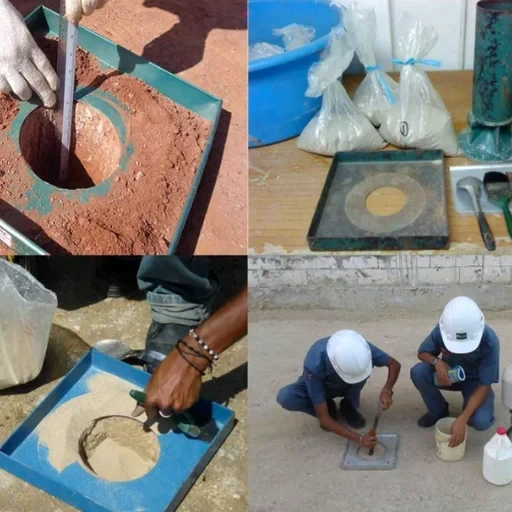
A recent commercial development off Route 9 near Lake Quinsigamond ran into trouble when trench backfill above a new stormwater detention system began settling within weeks of paving. The compaction looked adequate from the surface, but the engineer needed actual numbers, not a visual guess. Our crew mobilized a sand cone kit the next morning and tested six locations along the trench—three failed to reach 95% of modified Proctor density. Without that field data, the pavement would have cracked within two seasons. Worcester’s glacial till and outwash deposits, shaped by the retreat of the Laurentide Ice Sheet, create fill conditions that demand direct measurement; assumptions based on blow counts alone miss the variability. We run the sand cone test per ASTM D1556 because it gives a direct measurement of in-place density that contractors and geotechnical engineers can act on immediately. When fill contains cobbles or mixed urban debris common in older Worcester neighborhoods, we often pair the test with a grain size analysis to verify that the reference Proctor curve matches the actual material being placed.
A sand cone test measures the one thing that matters most in earthwork: the actual pounds of compacted soil per cubic foot—not an estimate from a nuclear gauge correlation.
Methodology and scope
The soil profile changes dramatically between the compact lodgement till dominating the western highlands near Worcester Polytechnic Institute and the looser stratified deposits in the Blackstone River floodplain. In the hilly sections around Indian Hill, well-graded gravels with silt matrices compact reliably and density tests tend to pass on the first attempt—provided the lift thickness stays under 8 inches. Down in the valley near the Canal District, however, we encounter layers of silty sand and organic remains from former mill ponds that require careful moisture conditioning and repeated passes with a sheepsfoot roller. The sand cone method shines in these contrasting settings because it measures density directly on a volume-displacement principle rather than relying on indirect correlations. Our field technicians carry calibrated Ottawa sand, pre-weighed jars, and a portable scale—the entire setup self-contained in a Pelican case that we can carry into basement excavations or up a slope behind a retaining wall. Each test point yields a wet density value, and we oven-dry the excavated material at our Worcester lab to calculate dry density and water content within 24 hours. This turnaround keeps earthwork schedules moving without guesswork.
Site-specific factors
Worcester’s growth from a mill town into New England’s second-largest city left a legacy of filled land—former Blackstone Canal sections, infilled millraces, and urban debris layers that appear in geotechnical borings without warning. When a contractor places structural fill over these zones and the earthwork inspector relies solely on a nuclear density gauge, the presence of buried brick, slag, or organic pockets can distort the reading and produce a false pass. The sand cone method avoids this pitfall because density is calculated from the actual weight of excavated soil divided by the measured volume of the test hole—there is no radiation source, no calibration drift with changing soil chemistry, and no dispute about the result. On a recent foundation backfill project in the Greendale neighborhood, the sand cone revealed a 6% density shortfall in a lift that the nuclear gauge had accepted; the contractor re-compacted the layer and saved the owner a future settlement claim. For compacted aggregate base under flexible pavement, we also run CBR testing to confirm that the structural section meets MassDOT design requirements before asphalt placement.
Quick answers
How much does a sand cone density test cost in the Worcester area?
A single sand cone test typically runs between US$90 and US$130 depending on site access, number of tests requested, and whether we need to run the companion laboratory Proctor. Mobilization within the Worcester metro area is included for projects with five or more test points.
When is the sand cone method preferred over a nuclear density gauge?
The sand cone is preferred when the fill contains materials that interfere with nuclear gauge readings—cobbles, slag, brick fragments, or high-organic soils. It is also the referee method specified in most earthwork contracts when there is a dispute over density results, because it provides a direct volume measurement without calibration to site-specific soil chemistry.
How long does a field density test take on site?
A single sand cone test takes about 15 to 20 minutes to complete the excavation and weighing, and another 24 hours to oven-dry the excavated soil for water content. We can usually provide preliminary dry density values the same evening and the final stamped report the next business day.
What acceptance criterion do Worcester building officials require?
Most building officials in Worcester follow IBC Chapter 18 and the MassDOT earthwork specification, which require structural fill to achieve at least 95% of the maximum dry density determined by ASTM D698. Some projects—particularly those with heavy foundation loads or pavement sections—may specify 98% or 100%, and we test against whatever standard the geotechnical engineer designated in the project specs.