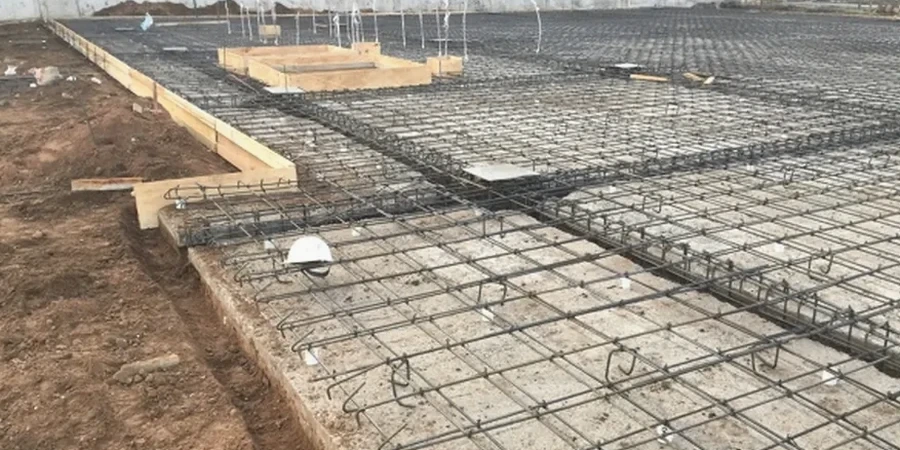
IBC Chapter 18 and ASCE 7 set the baseline for foundation design, but in Worcester the real challenge is the ground itself. The city sits on a mix of glacial till, outwash sands, and pockets of compressible silt left by Lake Hitchcock. A standard footing might work in one lot and fail in the next. That variability is exactly why we push for a raft/mat foundation approach on marginal sites. Instead of guessing at isolated bearing pressures, a mat spreads the load across the entire footprint and bridges soft spots that would otherwise require deep foundations. For projects in neighborhoods like Main South or along the Blackstone River corridor, we often combine the raft/mat design with a CPT test to map the transition from stiff till into softer lacustrine deposits before the concrete ever touches the ground.
A properly tuned mat foundation turns a marginal glacial till site into a buildable lot without importing a single yard of structural fill.
Quick answers
When does a raft/mat foundation make more sense than spread footings in Worcester?
When the allowable bearing pressure drops below about 2,000 psf, or when the total footing area would exceed 50% of the building footprint. Also, if the site has erratic fill, high groundwater, or adjacent historic structures that can't tolerate vibration from pile driving, a mat becomes the cleaner solution.
What does a raft/mat foundation design typically cost for a Worcester project?
For a typical commercial or mid-rise residential project in Worcester, the engineering design fee for a raft/mat foundation runs between US$1,000 and US$4,140, depending on the complexity of the soil profile, the number of column load cases, and whether buoyancy or seismic detailing is required.
How do you handle frost protection for mat foundations in Worcester?
Worcester's code requires a 48-inch frost depth. We either deepen the mat's perimeter beam below that line or specify rigid insulation extending horizontally from the slab edge, per ASCE 32. The choice depends on the site's drainage and whether the building is heated year-round.