← Home · Underground Excavations

Geotechnical Analysis for Soft Soil Tunnels in Worcester, MA

Together, we solve the challenges of tomorrow.

LEARN MORE →

IBC Chapter 18 and ASCE 7-22 set the bar for geotechnical investigations, but in Worcester the real challenge is the ground itself. The city sits on the remnants of Glacial Lake Hitchcock. That means thick sequences of varved silts and clays—soft, compressible, and unpredictable. When a tunnel alignment crosses under Main Street or runs parallel to the Blackstone River, you are not just dealing with low blow counts. You are dealing with time-dependent settlement, squeezing ground, and groundwater perched in sand lenses. In our experience, a standard field program is not enough here. We pair high-quality sampling with advanced lab testing because the varved clay will fool you if you only look at SPT numbers. For deep infrastructure, we often integrate the CPT test to capture continuous stratigraphy before deciding on face support pressures.

Worcester's varved clays will stand just long enough to give you false confidence—then they will close in on your shield.

Methodology and scope

Worcester grew fast during the canal era, and much of the downtown sits on fill over those old lake beds. The Blackstone Canal was filled in the late 1800s. That history matters. We have pulled up brick fragments, timber piles, and organic silt lenses from borings just 20 feet below street level near Union Station. Urban tunneling here is not like boring through Boston Blue Clay. Worcester's varved deposits alternate between silt and clay layers thinner than a credit card. This fabric controls undrained behavior. A tunnel boring machine can face sudden changes in face pressure over a few feet. Our approach leans on ASTM D1586 for sampling and ASTM D2487 for classification, but we go further. We run consolidated-undrained triaxial tests on undisturbed samples because remolded strength is irrelevant for predicting crown stability. What we see most often is that contractors underestimate the stand-up time in these soils. It is short. Very short. That is why we insist on pore pressure dissipation testing in the field. For those managing urban excavation risks, the deep excavations expertise becomes directly relevant when designing launch pits in constrained downtown blocks.
Geotechnical Analysis for Soft Soil Tunnels in Worcester, MA
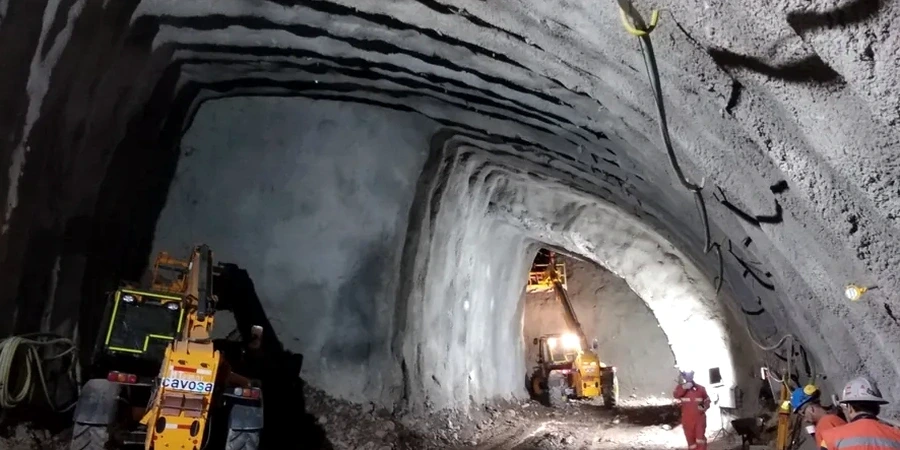
Technical reference image — Worcester

Site-specific factors

The most common mistake we see in Worcester is contractors treating the varved clay like a homogeneous soft clay. It is not. The silt seams drain quickly. The clay layers do not. When a TBM stops for maintenance, the face drains differentially. Pore pressures drop in the silt and stay high in the clay. The result is face slabbing. We have observed this in projects near the Worcester State University area where grade changes mask the true overburden pressure. Another error is relying on undrained parameters only. If you miscalculate the time-dependent consolidation around the tunnel, the settlement trough will be wider than predicted. That is how you get damage claims from brick buildings on Shrewsbury Street. The fix is not just more instrumentation. It is a ground model that respects the layered fabric and includes anisotropy.

Need a geotechnical assessment?

Reply within 24h.

Email: contact@geotechnical-engineering.vip

Reference parameters

ParameterTypical value
Undrained shear strength (Su)15 - 50 kPa in varved clay
Sensitivity (St)4 - 12 (medium to highly sensitive)
Plasticity Index (PI)12 - 35%
Overconsolidation Ratio (OCR)1.2 - 2.5 in upper 30 ft
Permeability (kv)1x10^-7 to 1x10^-9 m/s
SPT N-value (varved deposits)2 - 8 blows/foot
Face support pressure range0.6 - 1.2 bar (EPB mode)

Related services

01

TBM Face Pressure Design

We calculate EPB and slurry face pressures using Leca-Dormieux limit analysis, calibrated to Worcester's layered profile to prevent blowout and face collapse.

02

Settlement Trough Prediction

Three-dimensional finite element models accounting for consolidation and anisotropy in varved clay to protect adjacent historic structures.

03

Ground Improvement Design

We design compensation grouting and dewatering schemes for running ground conditions in the silt lenses common near the Blackstone River corridor.

04

Instrumentation Planning

We specify inclinometer arrays, piezometers, and extensometers for real-time monitoring of crown displacement in soft ground sections.

Reference standards

ASCE 7-22 (Minimum Design Loads), IBC 2021 (Chapter 18), ASTM D1586 (Standard Penetration Test), ASTM D2487 (Unified Soil Classification), ASTM D4767 (CU Triaxial Test), FHWA-NHI-10-034 (Tunnel Manual)

Quick answers

How much does a geotechnical analysis for a soft soil tunnel project typically cost in Worcester?

For a preliminary alignment study with deep borings and lab testing, costs generally range from US$3,650 for a limited scope to approximately US$15,630 for a full design-phase investigation with triaxial testing, pore pressure analysis, and numerical modeling.

Why is Worcester's varved clay so challenging for tunneling?

The varved clay from Glacial Lake Hitchcock is interbedded silt and clay. It has anisotropic permeability and low stand-up time. The silt drains quickly, the clay holds water, and the sensitivity means disturbance can cut undrained strength by more than half.

What lab tests are critical for tunnel design in these soils?

We always recommend consolidated-undrained triaxial tests (ASTM D4767) on undisturbed Shelby tube samples. Atterberg limits, grain size distribution, and oedometer tests for compressibility are also essential to define the settlement trough width.

Can you work in dense urban areas of Worcester with limited access?

Yes. We have performed investigations in tight alleyways and active streets near downtown Worcester. We can use limited-access drill rigs and combine borings with CPT soundings to minimize surface disruption while still building a reliable ground model.
Location and service area

We serve projects in Worcester and surrounding areas.

View larger map