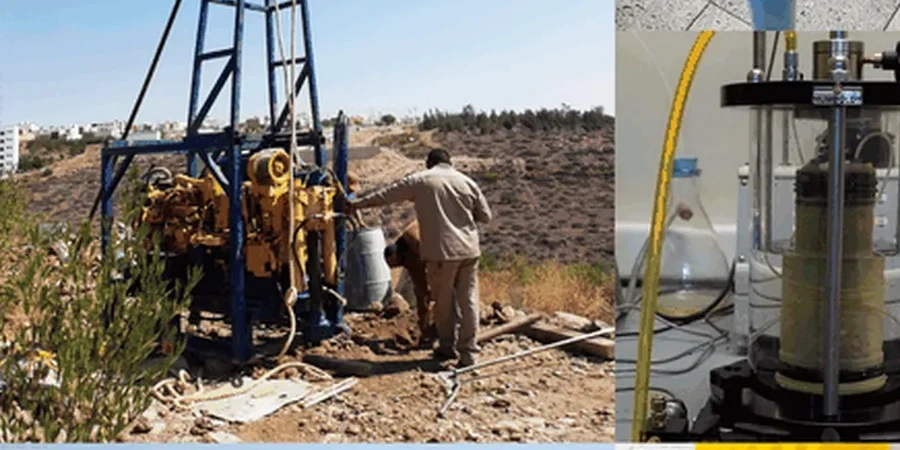
Worcester sits on a complex glacial landscape at roughly 480 feet above sea level, and anyone who has excavated near Pakachoag Hill or the Blackstone River knows the soil can change completely in a hundred feet. A soil mechanics study here is not a generic checklist; it is the difference between a foundation that holds and one that settles unevenly through a New England winter. We apply ASTM-standard field methods and laboratory testing to characterize the glacial till, outwash sands, and clay lenses that define the local subsurface. The data feeds directly into bearing capacity calculations, lateral earth pressure models, and settlement analysis required by the Massachusetts State Building Code. For projects near the steep slopes of Vernon Hill or the dense urban fill downtown, we combine the soil mechanics study with a slope stability analysis to catch failure surfaces before excavation begins.
A soil mechanics study in Worcester must read the glacial history of the site — till, outwash, or lacustrine clay — because each unit demands a completely different foundation logic.
Methodology and scope
We run the soil mechanics study from a mobile lab equipped with a triaxial frame, direct shear box, and consolidometers calibrated to ASTM D2487 and ASTM D4318. The team splits undisturbed Shelby tube samples right on site in Worcester, measuring undrained shear strength and compressibility within hours of extraction, which matters when you are dealing with sensitive Boston Blue Clay lenses that can appear in low-lying areas near Lake Quinsigamond. Grain size distribution, Atterberg limits, and moisture-density relationships are processed in parallel so the report delivers both classification and engineering parameters. For granular soils typical of the outwash plains west of I-190, we run relative density and permeability tests; for the stiffer glacial till around Airport Hill, we focus on strength parameters and bearing capacity. The lab follows internal QA/QC protocols aligned with ISO 17025, and every soil mechanics study includes a clear summary table of design values: cohesion, friction angle, modulus of elasticity, and allowable bearing pressure.
Site-specific factors
IBC Chapter 18 and ASCE 7-22 require a soil mechanics study for any structure in Seismic Design Category B or higher, which covers essentially all of Worcester County. The risk is not just theoretical: the city's dense glacial till is often underlain by softer varved clays and silt layers that can amplify ground motion during the moderate earthquakes the region does experience, such as the 2011 Mineral, Virginia event that was felt across Central Massachusetts. Skipping a proper soil mechanics study in Worcester means you are designing blind to potential liquefaction in saturated outwash deposits near the Blackstone River floodplain, long-term creep on clay slopes above Quinsigamond Avenue, or differential settlement where cut-and-fill transitions cross a building footprint. The Massachusetts State Building Code 780 CMR ties foundation design directly to the geotechnical investigation report, and the local building official in Worcester will not issue a permit without a sealed soil mechanics study from a licensed Professional Engineer.
Quick answers
What does a soil mechanics study in Worcester typically cost?
For a standard residential or light commercial project in Worcester, a complete soil mechanics study with field borings, lab testing, and a sealed engineering report generally falls between US$3,130 and US$5,370. The final cost depends on the number of borings, depth to refusal, and the lab testing suite required to satisfy IBC and local building code.
How deep do you drill for a soil mechanics study in Worcester?
Boring depth depends on the proposed foundation type and the site’s glacial geology. For shallow footings, we typically advance borings to 20–30 feet below grade, or until we reach dense glacial till with SPT N-values above 50. For deep foundations near the Blackstone River, borings can extend to 60 feet or more to characterize the bearing stratum and any softer underlying layers.
How long does it take to get the final soil mechanics study report?
Field work in Worcester usually takes one to two days. Standard laboratory testing requires about five business days, and the engineering analysis and report preparation add another three to four days. Most residential reports are delivered within two weeks; larger commercial projects with consolidation or triaxial testing may extend to three weeks.